



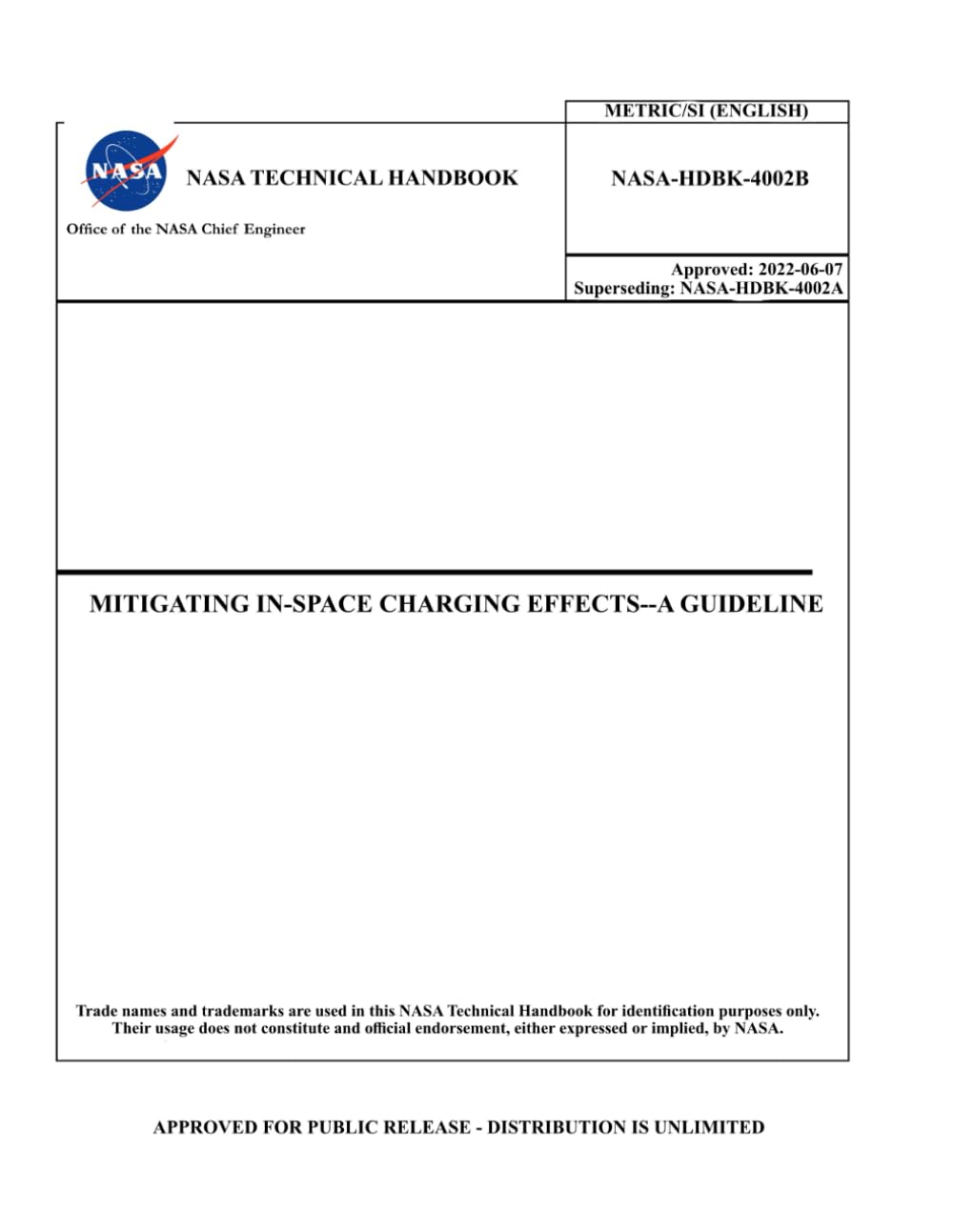
Mitigating In-Space Charging Effects—A Guideline: NASA-HDBK-4002B Approved: 2022-06-07 Paperback – October 11, 2025

 4.3 (87 items)
 Limited Time Sale
$22.38 cheaper than the new price!!
Free cash-on-delivery fees for purchases over $99
Product details
| Management number | 219250477 | Release Date | 2026/05/03 | List Price | $14.92 | Model Number | 219250477 | ||
|---|---|---|---|---|---|---|---|---|---|
| Category | |||||||||
MITIGATING IN-SPACE CHARGING EFFECTS--A GUIDELINENASA-HDBK-4002B Approved: 2022-06-07 Spacecraft charging is known to be a potential source of serious damage to spacecraft systems and has even been blamed for total spacecraft loss. This NASA Technical Handbook is intended to describe conditions under which spacecraft charging might be an issue, generally explain why the problem exists, list typical design solutions, and provide an introduction to the process by which design specifics should be resolved.This NASA Technical Handbook is also intended to be an engineering tool and is written at the graduate engineering level for use by aerospace engineers, system designers, program managers, and others concerned with space environment effects on spacecraft. Much of the environmental data and material response information has been adapted from published and unpublished scientific literature for use in this NASA Technical Handbook. As it is not possible to place all the necessary knowledge into one document, this NASA Technical Handbook should be used as a preliminary reference and/or checklist only. Its primary intent is to identify if spacecraft charging is an issue for a particular mission and suggest steps to mitigate its effects.Spacecraft charging, defined as the buildup of charge in and on spacecraft materials, is a significant phenomenon for spacecraft in certain Earth and other planetary environments. Design for control and mitigation of surface charging, the buildup of charge on the exterior surfaces of a spacecraft related to space plasmas, was treated in detail in NASA-TP-2361, Design Guidelines for Assessing and Controlling Spacecraft Charging Effects (1984). Design for control and mitigation of internal charging, the buildup of charge on the interior parts of a spacecraft from higher energy particles, was treated in detail in the original version of NASA-HDBK-4002, Avoiding Problems Caused by Spacecraft On-Orbit Internal Charging Effects (1999). NASA-HDBK-4002 was written as a companion document to NASA-TP-2361. In 2011, the previous version of this NASA Technical Handbook, NASA-HDBK-4002A, combined NASA-STD-4002 and NASA-TP-2361 with some further improvements. This NASA Technical Handbook is a companion document to NASA-STD-4005, Low Earth Orbit Spacecraft Charging Design Standard.Since the previous version, NASA-HDBK-4002A, there have been developments in the understanding of spacecraft charging issues and mitigation solutions, as well as advanced technologies needing new mitigation solutions. Those new developments were the motivation for this revision. Also, there have been many inputs and questions from the readers on the previous version. To address those, the typographical errors and errors in equations and tables are corrected, many figures are updated, and the statistical details for the environmental descriptions are improved. As in the heritage documents, the story still has unfinished business; and the proper way to address design issues for a specific spacecraft is to have skilled, ESD-knowledgeable engineers as part of the design team for those programs and missions where space charging is an issue. Read more
Bestseller ranking
Astronautics & Space Flight


Customers who viewed this product also viewed
Business

![AI Scrum: The Agile Inversion: A Project Leadership Framework for Every Team, Every Discipline [Print Replica] Kindle Edition](https://m.media-amazon.com/images/I/81uXBFwKnuL._SL1500_.jpg)


Correction of product information
If you notice any omissions or errors in the product information on this page, please use the correction request form below.
Correction Request Form